India’s ISRO (Indian Space Research Organization) launched its first interplanetary mission to Mars on 5th November 2013. After a journey for 298 days, finally the rocket PSLV – C25 could place the satellite in Mars orbit on September 14th 2014. India being the first country to achieve this feat in its maiden attempt is a wonderful feat. The satellite is performing well even today, well beyond its expectations of 6 months life period. Let’s get into the wonderful heroic, challenging, anxious, nervous incidents that transpired behind this mammoth Indian successful Indian Mars
Orbital Mission (MOM).
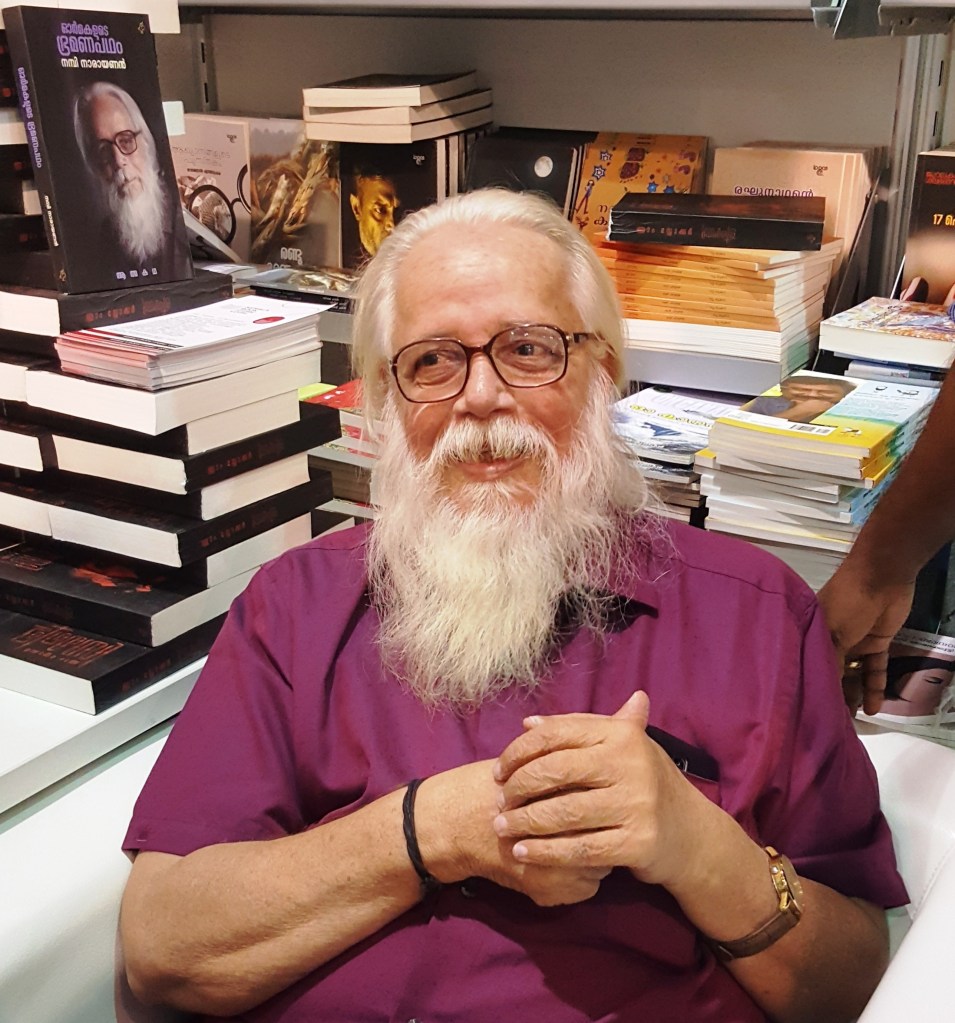
India needed Cryogenic engines to power the rockets that carries the satellite on vertical flight trajectory to Mars. Fund constraints at ISRO restricted the scope of its efforts to develop the engines on its own. Nevertheless it tied up with European Space Mission in France in 1974 through a deal to transfer the technology, in exchange of 100 man-years work from ISRO. The team was headed by Mr. Nambi Narayanan, a leading and aggressive scientist of ISRO in charge of Cryogenic division along with specifically selected engineers. Mr Nambi and team could successfully develop an engine and named it VIKAS as a first step using European technology. But this wasn’t sufficient for ISRO to develop Cryogenic and hence decided to import the same from Russia, at the time of dissolution of USSR in 1991. At this point of time due to the Western focussed suppression of India’s rising to a developed nation in the space technology arena, the shipment was forcefully abandoned during the process of shipments and India could import, through Pakistan, only partial portions of the cryogenic engine.
On 3rd November 1994, Influenced by the Western lobbies through Kerala Government arrested Mr. Nambi Narayanan, on false espionage charges for having sold the rocket technology to Pakistan. Through this action the development of Cryogenic engine (essential for interplanetary satellites launched through vertical trajectory) delayed and the progress of the ISRO crippled. Further ISRO’s aggressive space programs faced a grinding halt and spread shock waves among the ISRO engineers and the public.
One of the team members of Mr Nambi Narayanan (his son in law) Mr Subbiah Arunan, director of Mars Orbiter Mission initiated the responsibility of Mangalyan launch with the help of PSLV, powered by tweaked VIKAS engine developed by Mr Nambi Narayan and team in 1974. Mr. Nambi Narayanan was trained at NASA centre as well. He was offered a plum job by NASA with phenomenal benefits, that was turned down by him. The entire episode of India’s efforts for Cryogenic engine development , Mr. Nambi Naryanan’s arrest and other incidents was well captured in his biopic film ‘Rocketry’ by South Indian Actor R.Madhavan released in India on 1st July 2022.

How India could achieve the mission with much less powerful modified VIKAS engine? This challenge was resolved using I) Indians expertise to calculate the parameters of the planets and ii) by using the “Panchangam”. Most of the Indians have the basic knowledge in Astronomy through Panchangam that was completely based on our Astronomical expertise from our Vedas and Upanishads. We refer as Thither for days and divide them into two groups as Krishna Pasha (15 days prior to “Amavasya”, New Moon day) and Sukla Paksham (15 days prior to ‘Pournami” full Moon day). Each thithi is referred as a distance of 12 degrees between Sun and the Moon. In 15 thithis the separation will be 180 degrees, that’s when New Monday or Full Moon day happens. In addition to this their culture practices to use multiple parameters that are purely astronomical in fixing auspicious time, times to avoid, thithis to avoid etc., Further this Panchangam also helps us to determine the numerous parameters of the planets and their impact in the space.
With these inputs India decided to take the satellite to Mars after passing over the Earth’s strong gravitational forces. All the planets circulate the Sun in an elliptical orbits. As per our Astronomical calculations Mars comes closer to Earth in a cycle of 26 Months. PSLV-C25 did circulate the Earth for a month to reach trans Mars orbit. This was executed by placing the satellite in to Earth’s lower elliptical orbit initially and then using seven apogee rising orbital manoeuvres, completed burns and in the seventh burn placed the satellite into the trans Mars orbit successfully. Due to the less powerful Rocket engines PSLV ISRO could not take up the straight flight trajectory to Mars. This launch date was calculated to synchronize with the close proximity of Mars with Earth on the targeted date to place the satellite in the Mars orbit.
This is an amazing feat by India the 5th country after US, Russia, Europe and China and that too at a fraction of the cost of NASA. Russia, formally known as the Union of Soviet Socialist Republics (USSR) the Soviet Union, made multiple attempts in the 1960s to reach the Red Planet, and NASA soon followed with its Mariner 3 spacecraft. None of these early missions reached their target, or even got close, according to the NASA historical log of all Mars missions and RussianSpaceWeb.com. (https://www.space.com/13558-historic-mars-missions.html). NASA utilized few attempts and Russia, multiple attempts to reach Mars successfully. Both NASA and Russia used cryogenic engines to reach Mars through straight flight path. In the Solar astronomical system the multiple planets has varied gravitational forces on different days and time. They started these exploration as early as 1957 as per the information provided in space.com. While they had resources, their knowledge on the astronomy was limited and hence had to ignore the characteristics of Earth’s gravitational forces encountered during the straight flight trajectory to Mars.
Through this Indian achievement the Indian capability to break the Western power intentions to suppress India’s space growth was clearly evident. India did this time through Nambi Narayanan team, their grit and with the help of our rich knowledge through the Vedic texts, Panchangam. ISRO is releasing a 44 minute documentary film ‘YAANAM’ completely made in Sanskrit language on their Mangalyan mission to highlight the Indian power in the global scenario. Indian prime minister Mr. Narendra Modi in his 75th Indian independence day speech on August 15th, has vowed to take India as a super powered nation by 2047 formulating a 25 year plan. I wish the same to happen earlier.

 Kumaraguruparan Krishna
Good article
LikeLike
Thanks Swaminathan.
LikeLike
Very beautifully connected panchang to this subject. The celestial map with all information on the various planets, their gravitation pulls, sun’s flares deflection etc, all calculated perfectly 1000s of years ago. Astonishing fact.
LikeLike
Thanks Ammu.
LikeLike
Thanks Ammu
LikeLike
nice article. well done.
LikeLike
Thanks Nagu.
LikeLike
nice article.
LikeLike